Built for curious humans. No physics degree required.
Demystifying Quantum Computing
"If you think you understand quantum mechanics, you don't understand quantum mechanics." - Richard Feynman
Before we begin
Three important definitions.
⚛
What is Quantum?
The smallest possible unit of something. Nature comes in chunks, not smooth flows.
+ expand
The word comes from Latin - quantum means "how much."
In physics it means energy doesn't flow continuously. It comes in fixed, indivisible packets. Like pixels instead of paint.
Best analogy: Money is quantised. You can have £1.00 or £1.01 but not £1.005. The penny is the quantum of sterling. Energy at the subatomic level works the same way - no halves, no in-betweens.
Quantum mechanics is simply the study of how things behave at the scale where this discreteness dominates everything.
🌀
Superposition
A particle can be in multiple states simultaneously - until you look at it.
+ expand
Imagine flipping a coin. While it's spinning in the air it is, in a meaningful sense, both heads and tails at once. The moment it lands - the moment you observe it - it becomes one or the other.
Quantum particles work like a coin that's permanently spinning until something interacts with it.
The weird part: This isn't just our ignorance. The particle genuinely has no definite state. The universe is keeping its books in probabilities, not certainties.
For computing: A classical bit is a coin lying flat - 0 or 1. A qubit is a spinning coin - 0 AND 1 simultaneously. This is where the power comes from.
👯
Quantum Entanglement
Two particles linked so that measuring one instantly affects the other - anywhere in the universe.
+ expand
Imagine a pair of magic gloves. You put one in a box and ship it to Tokyo. You open your box in Dublin - it's a left glove. At that exact moment, without any signal, the Tokyo glove becomes a right glove. Instantly.
Not science fiction: This has been confirmed experimentally thousands of times. It is one of the most robustly verified phenomena in all of physics.
Einstein hated it. He called it "spooky action at a distance" and spent years arguing it proved quantum mechanics was wrong. He was mistaken.
For computing: Entanglement lets qubits coordinate instantly across an entire system, giving quantum computers their extraordinary combinatorial power.
See it for yourself
The Double-Slit Experiment. The weirdest thing that's definitely true.
Fire particles one at a time through two slits. When nobody's watching, they create an interference pattern - as if each particle went through both slits. Add a detector to watch which slit it goes through, and the pattern disappears. The particle knew it was being observed.
Interactive: Double-Slit Experimentclick buttons to toggle
Particles: 0
Classical vs Quantum
Bits vs Qubits. Not faster. Different.
A quantum computer isn't a faster classical computer. It's a fundamentally different kind of machine - like comparing a car to teleportation.
0
Classical bit
Off. Definitely off.
1
Classical bit
On. Definitely on.
vs
0+1
Qubit
Both. Until measured.
Interactive: Qubit State on the Bloch Spheredrag to rotate - click buttons to apply gates
State: |0⟩
What am I looking at?
This sphere is a way to visualise every possible state a qubit can be in. Think of a globe: the north pole is 0, the south pole is 1. A classical bit can only ever be at one pole or the other. A qubit can be anywhere on the surface — and its position tells you the probability of measuring 0 vs 1.
Try the buttons and watch the dot move:
Hadamard (H) — puts the qubit into a 50/50 superposition (moves it to the equator). Apply it again and it snaps back. This is how quantum algorithms explore many possibilities at once.
Pauli-X (flip) — flips 0 to 1 or 1 to 0. It's the quantum version of a NOT gate — the dot swings from one pole to the other.
Pauli-Z (phase) — doesn't change the odds of measuring 0 or 1, but rotates the qubit's phase (its position around the equator). Phase is what lets qubits interfere with each other to amplify right answers and cancel wrong ones.
Measure — forces the qubit to pick a side. It collapses from wherever it is on the sphere to either the north pole (0) or south pole (1). Once measured, the superposition is gone.
2
states a classical bit can represent
2ⁿ
states n qubits can represent simultaneously
300
qubits can represent more states than atoms in the observable universe
~0
useful algorithms exist that exploit this fully. Yet.
Under the hood
How do they actually build the things?
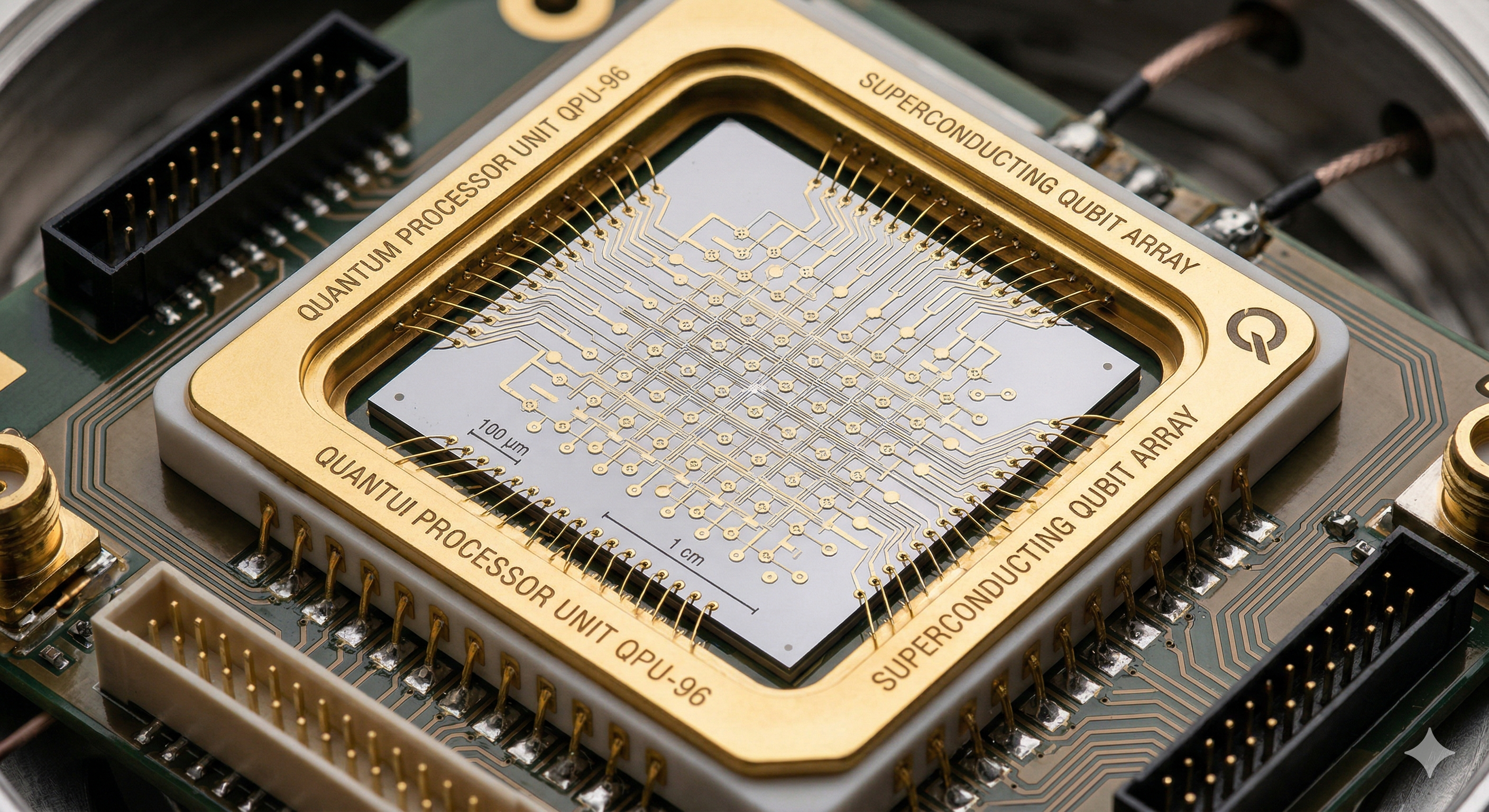
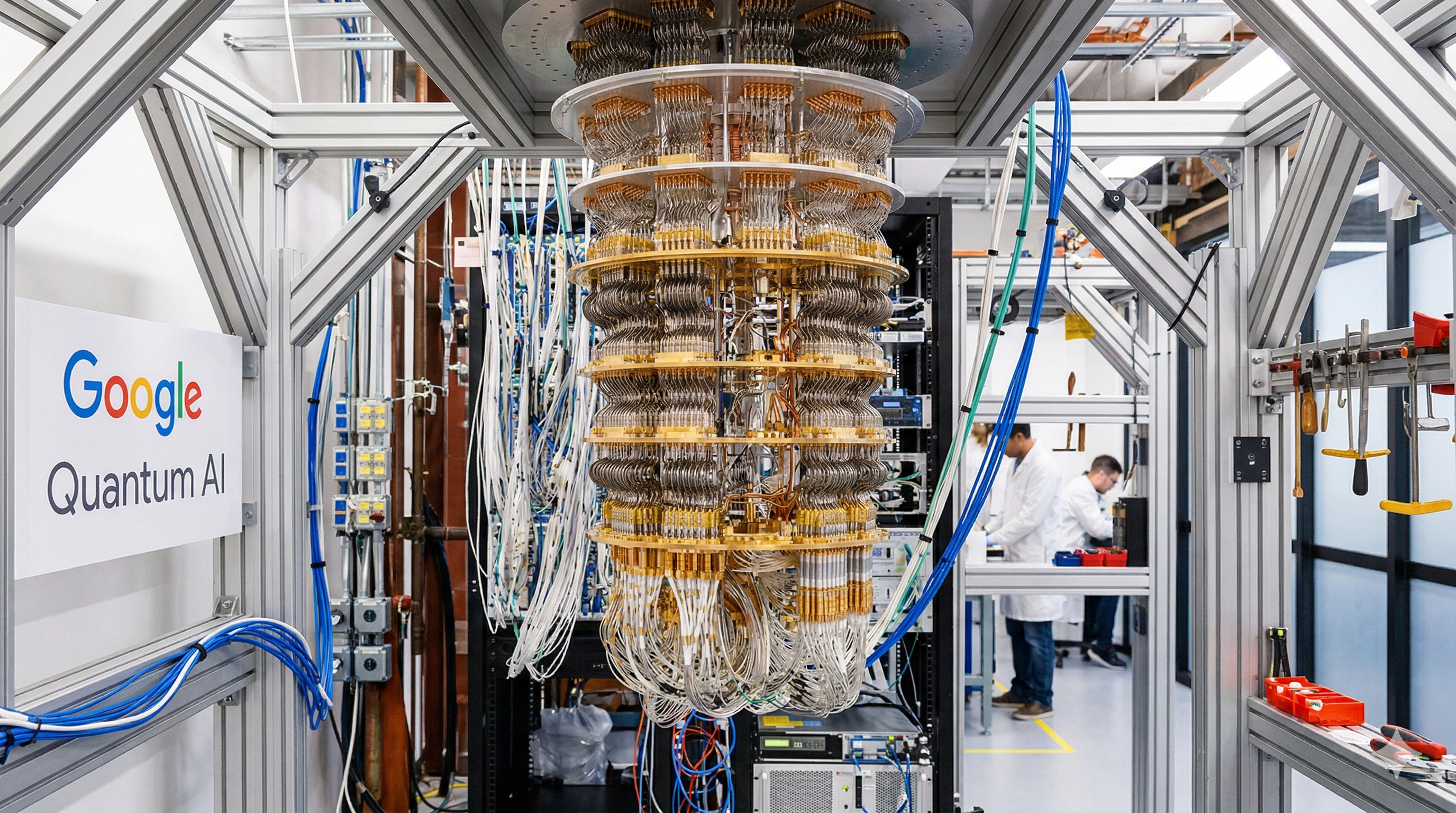
Google and IBM use superconducting qubits - tiny circuits made from superconducting materials cooled to near absolute zero. The machines look like chandeliers designed by a supervillain.
Anatomy of a quantum processor chipGoogle Bristlecone-style architecture
Illustration based on Google's Bristlecone processor architecture (72 qubits, 2018). MIT Technology Review →
−273°C
Operating temperature. Colder than deep space, which is −270°C
µs
Coherence time. Microseconds before the quantum state dissolves into noise
~1%
Error rate per gate operation. Compounds devastatingly over millions of operations
1,000:1
Physical qubits needed per logical qubit with current error correction
Getting into superposition
A qubit starts in a definite ground state - 0. A precisely timed microwave pulse is fired at it, nudging it into an equal superposition of 0 and 1. This operation is called a Hadamard gate. The timing must be accurate to nanoseconds. Too long and it flips to 1. The sweet spot in the middle is superposition.
Creating entanglement
Two qubits are connected by a physical coupling element. A precisely timed sequence of microwave pulses causes them to interact - their quantum states become correlated. The operation is called a CNOT gate. After it, neither qubit has a definite state, but their states are locked together. Measure one and the other is instantly determined.
Interactive: Quantum Entanglemententangle two qubits then measure one
State: Independent
Steering the superposition
The algorithm is a carefully choreographed sequence of quantum gates. Through interference - the same phenomenon that makes noise-cancelling headphones work - wrong answers cancel each other out and the right answer is amplified. When measured, the correct result emerges with overwhelming probability.
"It's like having every possible answer written on a piece of paper, then waving them so the wrong ones cancel out and the right one glows. When you look - you see the glowing one."
The brutal truth about fragility
Qubits are destroyed by heat, vibration, stray electromagnetic fields, and cosmic rays. This is called decoherence - the qubit's quantum state leaks into the environment. You have microseconds to perform your entire computation. IBM's largest systems must manage heat loads measured in nanowatts. The machines are the most fragile objects humanity has ever deliberately constructed.
"We have built the most sophisticated, expensive, and fragile thing humanity has ever constructed, and it loses its mind if someone nearby makes a cup of tea."
The origin story
How we got here. It starts with an apple.
This is not the story of engineers building a better computer. It's the story of two old men arguing about whether God plays dice - and how that argument accidentally produced what is likely to become one of the most powerful computational tools in history.
Theory
Experiment
Person
Computing
Milestone
↓ tap any card to expand
Reality check
Where we actually are. Honestly.
The most important milestone in quantum computing happened in 2023. Google published a paper demonstrating that as they increased the size of their error correction code, error rates decreased exponentially. This is called being below threshold.
What "below threshold" means
More error-correction qubits → better error rates, not worse. The fundamental physics works. The remaining challenges are purely engineering. This is the Wright Brothers getting off the ground - not for long, not far, not carrying anything useful, but definitively proving the thing works in principle.
53
Qubits in Google's Sycamore (2019) - claimed quantum supremacy
1,000+
Qubits in IBM Condor (2023) - but qubit count is the wrong metric
Logical qubits needed to run Shor's algorithm meaningfully
Who should actually worry — and who shouldn't
The quantum computers that could break today's encryption do not yet exist. The timeline for a cryptographically relevant quantum computer is 10–15+ years at the optimistic end. But that doesn't mean nobody should be paying attention. Here's how to think about it honestly.
WORRY NOW
Governments, defence, intelligence, healthcare holding long-lived secrets. The real threat today is "harvest now, decrypt later" — adversaries collecting encrypted data right now with the intention of decrypting it once quantum computers arrive. If your secrets still matter in 15 years (state secrets, medical records, defence communications), migrating to post-quantum cryptography is a legitimate priority. NIST has already published post-quantum encryption standards. This work should be underway.
DON'T PANIC
Everyone else. Your bank login, your emails, your company's VPN — these use encryption that refreshes constantly. Even if a quantum computer broke one session key, it wouldn't matter because that key is already expired. The data most people protect doesn't need to stay secret for 15 years. When quantum-safe standards roll out (they're already being adopted), your software will update and you'll barely notice.
WATCH OUT FOR
Vendors selling "quantum-proof firewalls," "quantum-safe VPNs," and "quantum-resistant endpoint solutions" as an emergency. If someone is charging you a premium to solve a problem that doesn't affect you yet, ask them: "quantum-proof against what, exactly?" The threat to everyday encryption is real — eventually. But if they learned the word "qubit" last Tuesday, check their pockets.
The sensible approach: understand the shape of what's coming. Don't panic. Don't ignore it. Follow NIST's post-quantum migration guidance if you handle sensitive, long-lived data. For everything else — your Tuesday meeting notes are safe.
IBM's roadmap
IBM has publicly committed to verified quantum advantage by 2026 and fault-tolerant quantum computing by 2029. Whether they hit those dates is an open question - but the fact that a trillion-dollar company is publishing concrete timelines tells you the engineering trajectory is real.
Google's roadmap: six milestones to a useful quantum computer
Google has published a six-step roadmap for reaching a large-scale, error-corrected quantum computer. Two milestones are already complete. Here's what each one means in practice.
MILESTONE 1 — BEYOND CLASSICAL ✓ 2019
54 physical qubits. Google's Sycamore chip did a specific calculation in 200 seconds that would take the best classical supercomputer thousands of years. It proved quantum computers can do something no regular computer can — but that something was an artificial benchmark, not anything useful yet. Think of it as proving the engine works, even though you haven't built the car.
MILESTONE 2 — QUANTUM ERROR CORRECTION ✓ 2023
~100 physical qubits. Error rate: 1 in 100. Showed that grouping many physical qubits into one "logical qubit" actually makes errors go down as you add more qubits — not up. Before this, adding more qubits just added more noise. This is the moment quantum computing stopped being a losing battle against physics. Like proving that adding more workers to a project actually speeds it up instead of creating more confusion.
MILESTONE 3 — LONG-LIVED LOGICAL QUBIT
~1,000 physical qubits. Error rate: 1 in 1,000,000. Building a single logical qubit that stays accurate long enough to be useful. Right now, even with error correction, logical qubits don't survive long enough for serious calculations. This is the difference between a battery that dies in seconds and one that lasts long enough to actually power something.
MILESTONE 4 — CREATING A LOGICAL GATE
~10,000 physical qubits. Error rate: 1 in 1,000,000. One reliable qubit isn't enough — you need reliable qubits that can talk to each other. A logical gate means two error-corrected qubits can perform an operation together without introducing new errors. Going from having one reliable musician to having a reliable duet — the beginning of actual computation.
MILESTONE 5 — ENGINEERING SCALE-UP
~100,000 physical qubits. Error rate: 1 in 1,000,000. Take everything that works at small scale and mass-produce it. At this point, quantum computers could start tackling real problems — simulating molecules for drug discovery, optimising logistics networks, cracking certain types of encryption. This is where quantum goes from lab curiosity to something businesses actually want to buy.
MILESTONE 6 — LARGE ERROR-CORRECTED QUANTUM COMPUTER
~1,000,000 physical qubits. Error rate: 1 in 10 trillion. The end goal. A machine that could simulate complex chemical reactions atom by atom, break current encryption standards, optimise entire economies, and solve problems we can't even formulate today because we've never had a tool powerful enough to attempt them. This is the "general-purpose quantum computer" people talk about when they say quantum will change everything.
Each step roughly multiplies the qubit count by 10×. Google has ticked off the first two. Most experts think milestone 6 is still 10–15+ years away, but progress has been faster than many predicted.
The things that keep physicists up at night. In a good way.
The first practically useful thing a quantum computer will probably do isn't break encryption or revolutionise AI. It'll discover a molecule.
🧬
Drug Discovery
Simulating molecular interactions that classical computers cannot model.
+ expand
Simulating how a drug molecule interacts with a protein requires modelling quantum interactions between hundreds of atoms. On a classical computer this requires approximations so severe they can miss the right answer entirely.
A quantum computer simulates these interactions natively - using the same quantum rules the molecules themselves follow. This could reduce drug discovery from decades to years.
⚡
Room-Temperature Superconductors
The most transformative material discovery in human history - if we can find it.
+ expand
A material that conducts electricity with zero resistance at room temperature would transform everything: lossless power grids, revolutionary computing, practical fusion energy, cheap MRI machines for developing countries.
The reason we haven't found one: predicting whether a material will superconduct requires simulating quantum interactions between thousands of electrons. Classical computers cannot do this accurately. Quantum computers can - in principle.
This is almost exactly what Feynman had in mind in 1981.
🤖
AI + Quantum
The two most transformative technologies of our era are converging.
+ expand
AI is already helping quantum computers - using machine learning for error correction, autonomous calibration, and circuit optimisation.
The exciting scenario: AI makes quantum computers more reliable → better quantum computers run better simulations → better simulations discover better materials → better materials make better quantum computers. A positive feedback loop between two civilisation-scale technologies.
If that loop kicks in, the pace of progress stops being linear.
The honest timeline
We are in the vacuum tube era of quantum computing. The trajectory is clear. The destination is not yet in sight. The people saying it'll change everything in 5 years and the people saying it's all hype are both wrong.
The wisest thing you can do is understand the shape of what's coming - not panic, not ignore it, and absolutely do not buy a quantum-proof firewall from someone who learned the word "qubit" last Tuesday.
The discovery that changes everything
Room-Temperature Superconductors. The single greatest leap in human evolution.
Every few decades, a material discovery reshapes civilisation. Bronze. Iron. Steel. Silicon. But there is one material we haven't found yet that would make all previous discoveries look incremental. A superconductor that works at room temperature and ambient pressure - a material that conducts electricity with zero resistance under normal conditions - would be, by a wide margin, the most transformative discovery in the history of our species.
This isn't hyperbole. Let's walk through exactly what it would change.
The problem today: resistive loss
Right now, the global power grid loses approximately 8–15% of all generated electricity as heat during transmission. That's hundreds of billions of kilowatt-hours - wasted. Every year. Burned off as heat in copper and aluminium wires because every conductor we have resists the flow of electrons.
Generated electricity~10% lost as heat
With room-temp superconductor~0% lost
A room-temperature superconductor turns every wire on Earth into a lossless channel. The energy we already generate becomes enough.
⚡
The Power Grid
Electricity generated in the Sahara by solar farms could be transmitted to London, Tokyo, or São Paulo with zero loss. The constraint that power must be generated near where it's consumed vanishes overnight. Every developing nation gains access to cheap, abundant energy.
Global energy waste eliminated: ~2,000 TWh/year
🚀
Transportation
Superconductors enable magnetic levitation without continuous energy input. Maglev trains that float on permanent superconducting magnets - near-silent, frictionless, and operating at aircraft speeds. Intercity travel measured in minutes, not hours.
Tokyo to Osaka: 15 minutes. London to Edinburgh: 25 minutes.
🔬
Medicine
MRI machines currently cost £1–3 million because they require liquid helium cooling for their superconducting magnets. Remove the cooling requirement and the cost collapses by 90%. Every rural hospital, every developing nation, gets access to advanced diagnostic imaging.
MRI cost reduction: from £2M to ~£200K
⚛
Fusion Energy
The single biggest engineering bottleneck in nuclear fusion is containing plasma at 150 million degrees. This is done with superconducting magnets - currently cooled to near absolute zero at staggering expense. Room-temp superconductors make fusion reactors dramatically simpler, cheaper, and closer to commercial viability.
Unlocks: practically unlimited clean energy
💻
Computing
Every computer processor generates heat because electricity meets resistance. Remove resistance and processors can run faster, denser, and cooler. Quantum computers - which currently need to operate at −273°C - could potentially work at room temperature. The chandelier becomes a desktop.
Quantum computing: from lab curiosity to consumer hardware
🌎
Climate Change
Combine lossless power transmission with cheaper fusion and solar. Energy becomes so abundant and cheap that carbon capture, desalination, and direct air capture become economically viable at planetary scale. The economics of decarbonisation flip from impossible to inevitable.
The cost curve of saving the planet bends permanently downward
Why quantum computing is the key
Here's the connection. The reason we haven't found a room-temperature superconductor isn't that it can't exist - it's that predicting whether a material will superconduct requires simulating quantum interactions between thousands of electrons simultaneously. Classical computers can't do this. The possible configurations grow exponentially - a molecule with 100 electrons has more possible states than atoms in the universe.
A quantum computer simulates these interactions natively - using the same quantum rules the electrons themselves follow. This is exactly what Feynman proposed in 1981. He wasn't imagining a faster calculator. He was imagining a tool that could find the material that changes everything.
The feedback loop
And this is where it gets truly extraordinary. A sufficiently powerful quantum computer discovers a room-temperature superconductor. That superconductor makes quantum computers cheaper, more reliable, and operable without cryogenic cooling. Better quantum computers discover better materials. Better materials make better quantum computers. A positive feedback loop between two civilisation-scale technologies, each accelerating the other.
This is not a linear trajectory. This is the ignition point for exponential progress in materials science, energy, medicine, and computation - simultaneously.
$400B+
estimated annual economic impact of lossless power transmission alone
0
resistance. Zero. Every electron that enters a wire exits the other end.
1047
possible electron configurations in a candidate material - unsimulable classically
∞
persistent current. A superconducting loop carries current forever with no energy input.
Down the rabbit hole
Does superposition mean we're living in a simulation?
Here's the thought that keeps certain physicists (and quite a few game developers) staring at the ceiling at 3am. Superposition tells us that particles don't have definite properties until they're observed. The universe doesn't seem to bother resolving the state of something until something needs to know.
If that sounds familiar, it should. It's exactly how a modern game engine works.
The rendering engine analogy
In a video game like Red Dead Redemption 2 or Cyberpunk 2077, the game engine doesn't render the entire world at once. That would be absurdly expensive. Instead, it uses a technique called frustum culling and level-of-detail (LOD) rendering: only what the player's camera can see gets fully rendered. Objects behind you? They don't exist in detail. Turn around, and they pop into high resolution. Look away, and they simplify again.
The game only computes what's being observed.
Game rendering engine
Only renders what the camera sees
Objects outside the player's view exist as simplified data - bounding boxes, low-poly placeholders. The moment the camera turns toward them, the engine loads full geometry, textures, and lighting in real time.
Why? Because computing everything everywhere all the time is computationally impossible. You optimise by only computing what's being observed.
A particle in superposition has no definite state - it exists as a probability cloud across all possible values. The moment a measurement is made (an "observer" interacts with it), the wavefunction collapses to a single definite outcome.
Why? Nobody knows. But the mathematical structure is strikingly similar: don't compute the result until something needs to read it.
if (particle.isBeingObserved()) {
collapse(wavefunction);
return definiteState;
} else {
// remain in superposition
maintain(probabilityCloud);
}
Interactive: Lazy Rendering vs. Quantum Observationmove your cursor to "observe" - particles resolve only where you look
Cursor = Observer. Particles only resolve where you look.
The double-slit experiment is the most direct parallel. Fire an electron at two slits with no detector - it passes through both simultaneously and creates an interference pattern. Add a detector to observe which slit it goes through - the interference vanishes. The electron goes through one slit, like a normal object.
The universe appears to be doing exactly what a well-written game engine does: deferring expensive calculations until the result is actually needed. In computer science, this is called lazy evaluation. In quantum mechanics, they call it the measurement problem.
Planck limits - resolution and frame rate
There's another strange coincidence. Reality has hard-coded limits. The Planck length (~1.6 × 10⁻³⁵ metres) is the smallest meaningful distance. The Planck time (~5.4 × 10−44 seconds) is the smallest meaningful interval of time. Nothing can be smaller. These are, in a sense, the pixel size and frame rate of the universe - exactly the kind of hard limits you'd expect in a simulation running on finite hardware.
Even the speed of light starts to look like a maximum data transfer rate - a bandwidth cap baked into the engine.
The honest caveat
This is philosophy, not physics. The simulation hypothesis is not falsifiable with current tools - which means it's not, strictly speaking, a scientific theory. The resemblance between quantum mechanics and computational optimisation might be a deep clue about the nature of reality, or it might be a coincidence shaped by the human tendency to see patterns everywhere. What it definitively is: one of the most interesting questions we can't yet answer.
"The universe is under no obligation to make sense to you." - Neil deGrasse Tyson. But it is suspiciously well-optimised.